Performative Diagrammatics
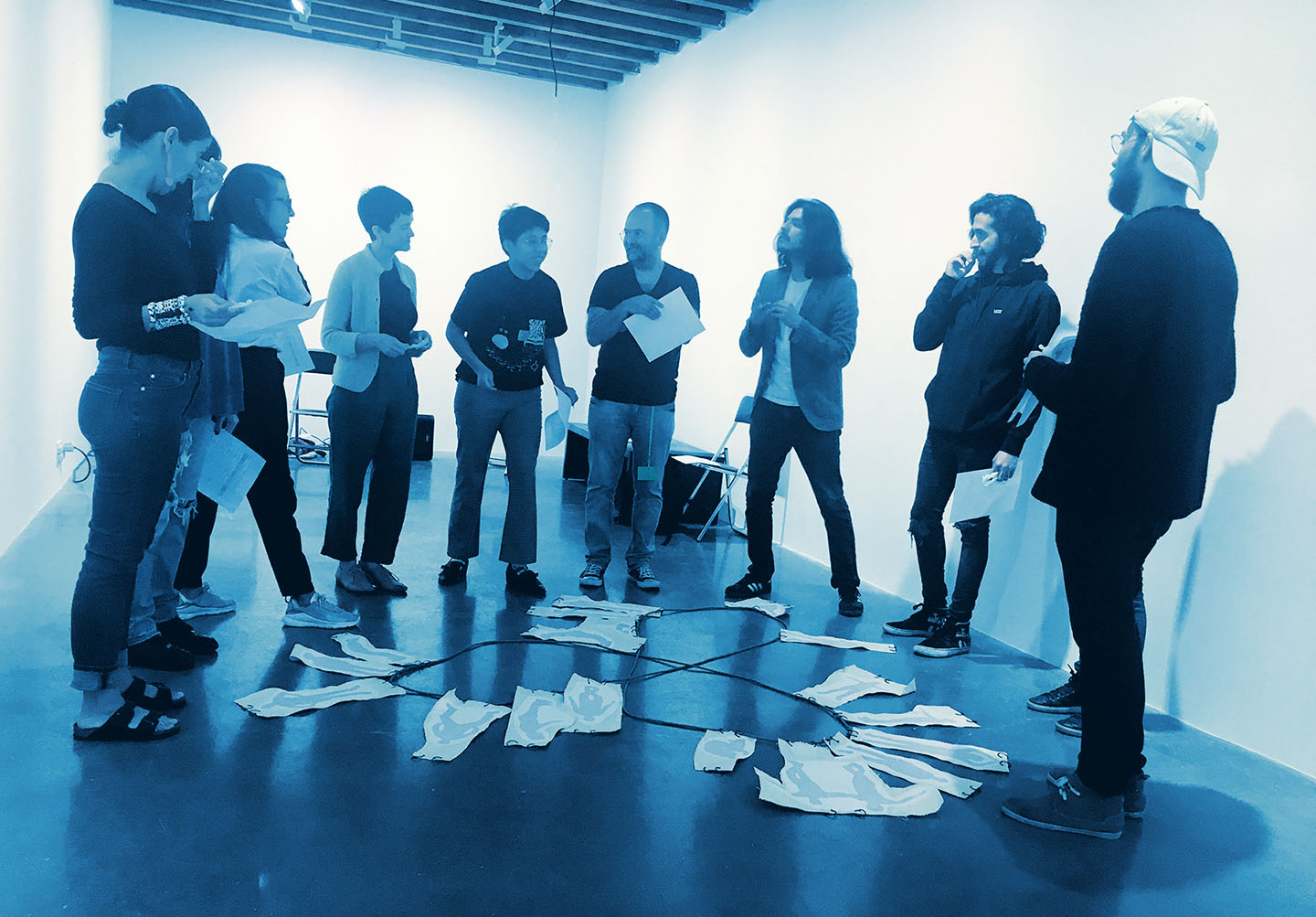
Ten people standing and speaking, in a semi-circle around a diagrammatic instrument on the ground. The diagrammatic instrument is a large trefoil knot on the ground that has images of people in various poses attached to it.

Performative Diagrammatics is an artistic methodology rooted in presence and conversation. Through this work, I build three-dimensional Diagrammatic Instruments that translate visual diagrams into physical playing fields. Animated through facilitated workshops, these instruments offer open categorical armatures, inviting participants to populate them with their own lived experiences, values, and working methods. This collaborative dynamic brings implicit background practices into view, allowing artists and communities to articulate emergent strategies and cultivate fresh potentials for action.

Facilitating as Creative Practice becomes the generative core of these encounters. Seeing it at work all around me, I now foreground facilitating as an artistic discipline in its own right.

The image above shows a "Micro-practices for a New Gentleness" workshop, at Kurimanzutto, Mexico City, in 2020.

Fractal 3-Line Matrix Instrument
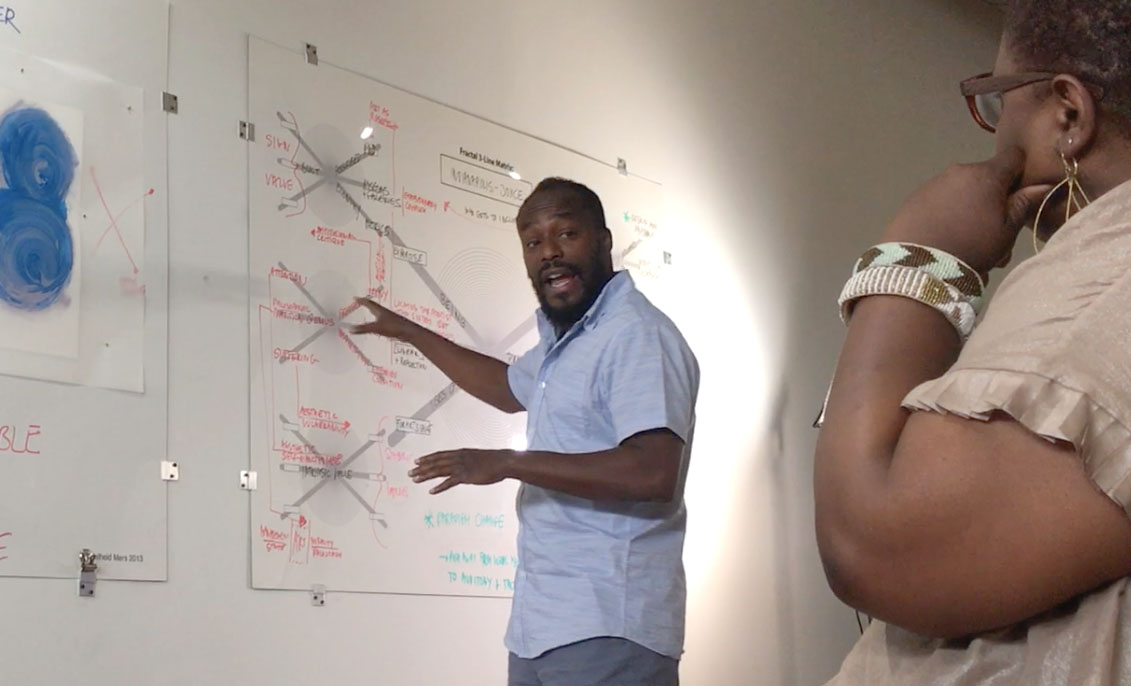
The Fractal 3-line Matrix is an instrument to generate an interpretation of a text. It emerged from attempts to diagram large amounts of information, for example notes from an entire conference. As it is, it can serve to parse any text, be it a book, or a narrative about situating oneself. The Fractal 3-Line Matrix offers four levels of interaction, which I deploy in order, but you may explore differently. I call them triadic, binary, fractal, and symmetric. The image above was taken in my studio in Chicago, in conversation with Tracie Hall and DeAmon Harges, comparing notes during a follow-up meeting to the 'Artist as Problem Solver Convening' Tracie Hall had organized and DeAmon had responded to on site. More

The Braid Instrument
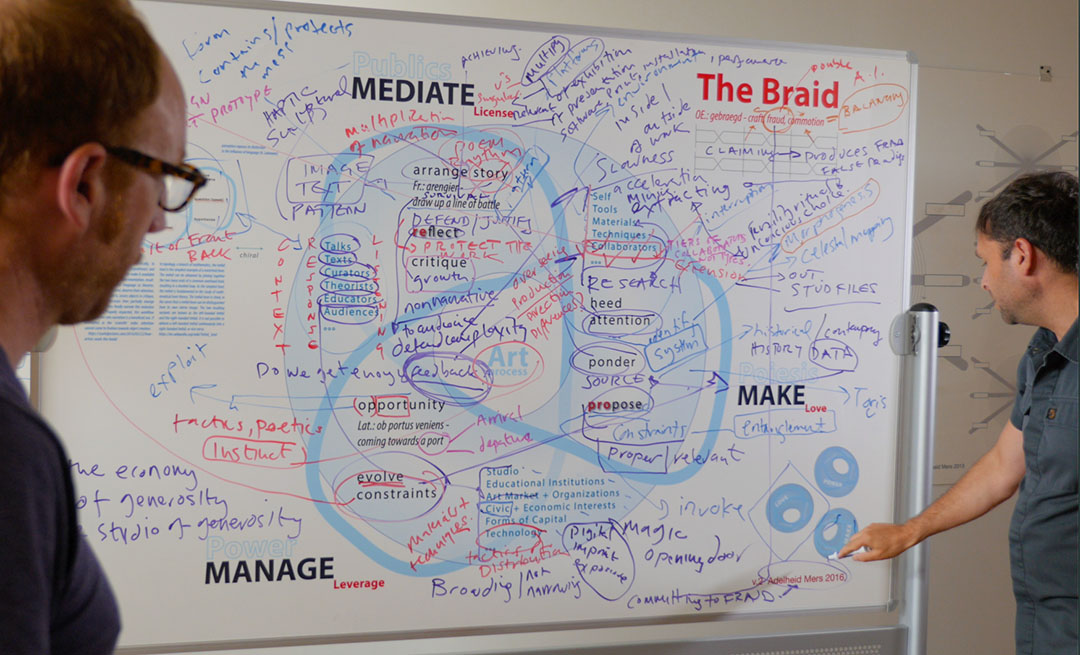
The Braid diagram models doing, knowing and being as fundamental building blocks of articulating sense. Derived from conversations with artists about how they work, the initial categories were making, mediating and managing, mapped onto a torus traversed by a trefoil. These mathematical shapes evoke topology as a metaphor that models and also braces the practices of cultural and other practitioners. The Braid instrument has migrated from a drawing to a spatial object. Using The Braid performatively foregrounds questions of valuing. The image above was taken in my studio in Chicago, in conversation were artists Mark Jeffery and Judd Morrissey. More
Performative Topologies Instrument
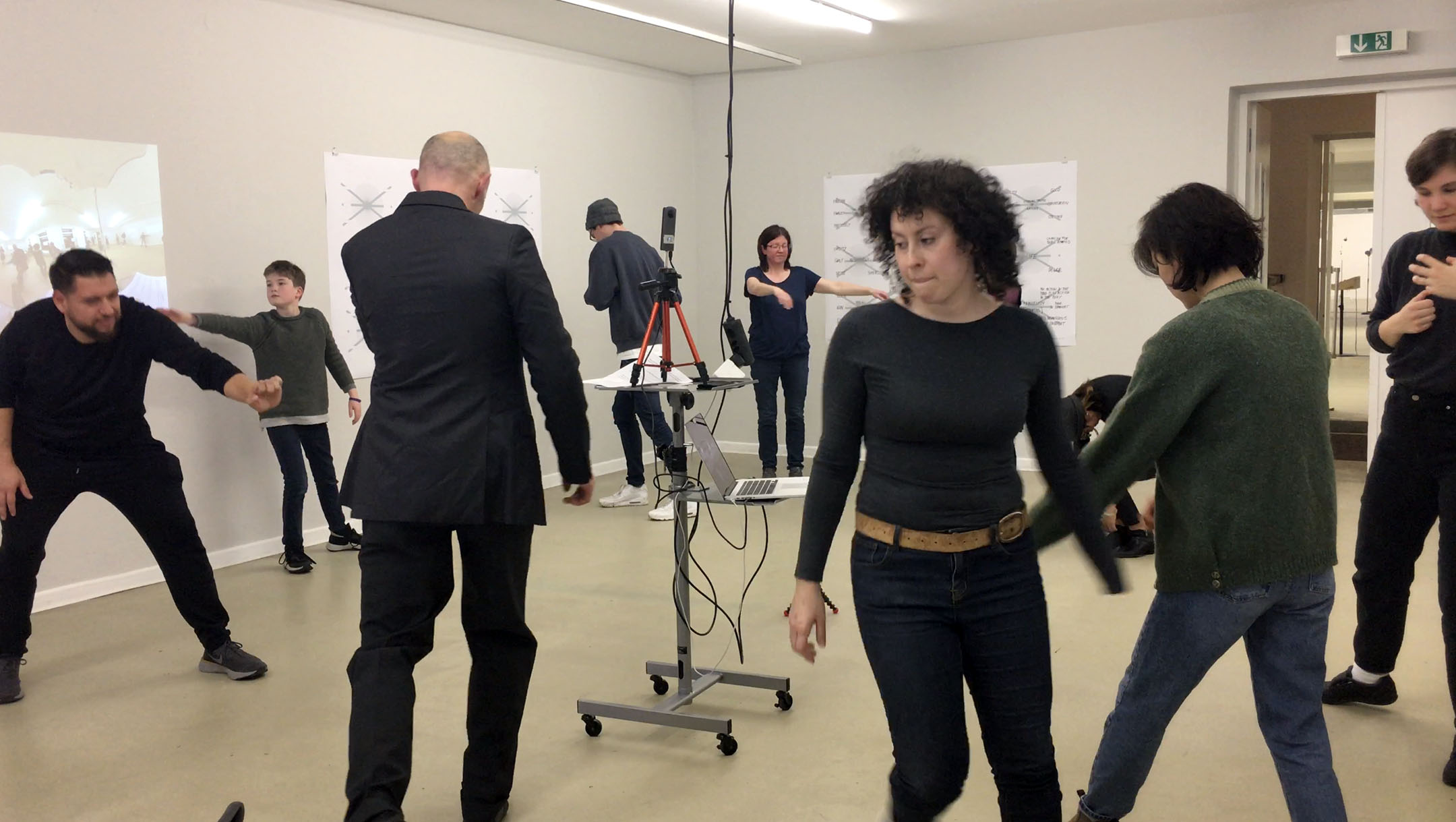
Performative Topologies is an ephemeral instrument. Verbal prompts shape an interaction between several participants and a facilitator. The process is structured around open sharing of the memory of an object, and shifting between modes of engaging with this memory. Depending on the time allotted, conversations may be swift or probe an experience more deeply. The last step of the sequence consists of jointly performing iterations of a personal movement sequence that emerges from the process. This is when ‘art happens’ visibly, as a polyrhythmic, emergent choreography. A diagram is taking place, supported by a feedback loop from a 360-degree camera. The image was taken in 2019, at the exhibition, "Membrane", in Berlin. More

Micro-practices for a New Gentleness Instrument
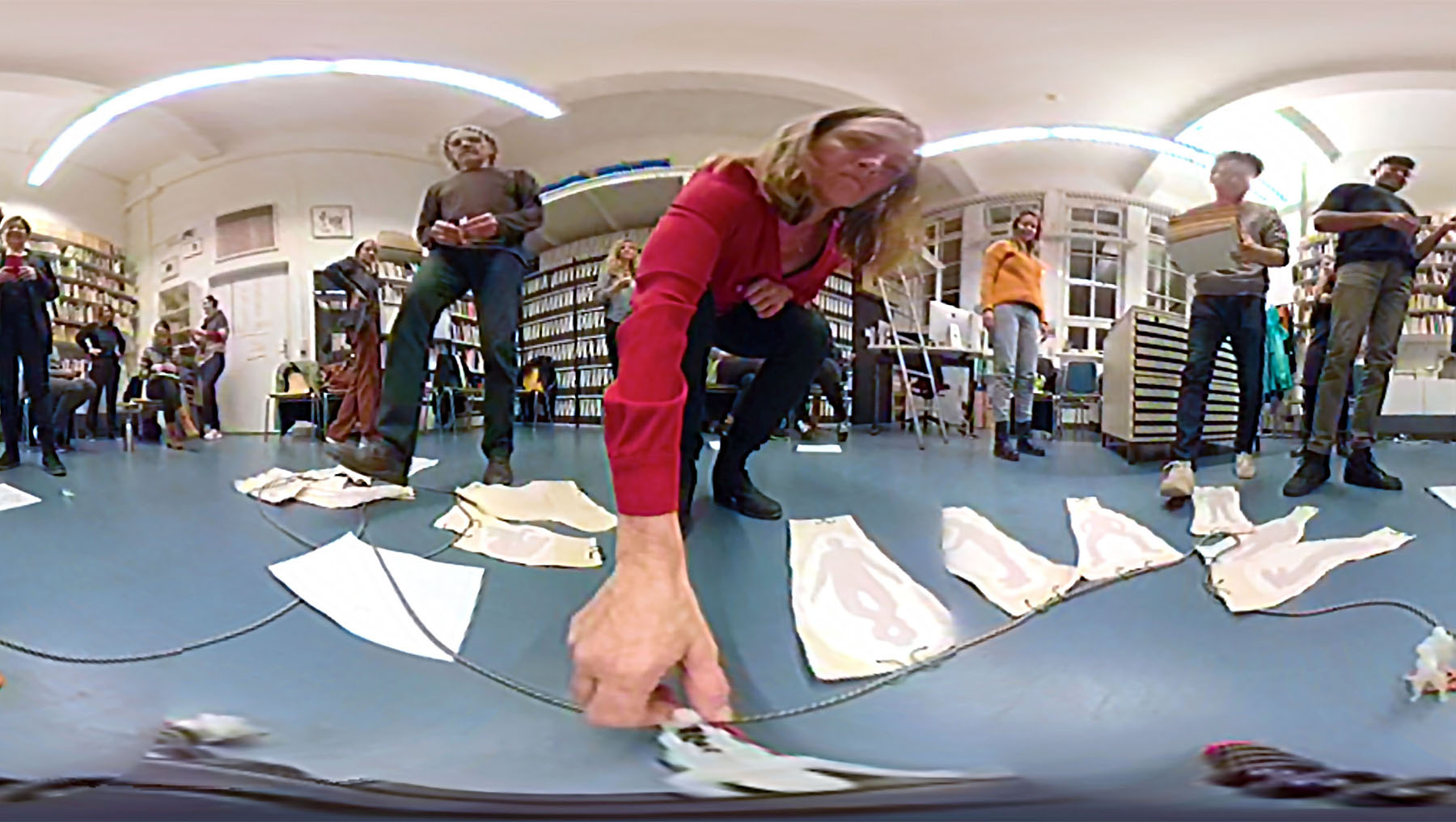
Micro-practices for a New Gentleness is a score of 18 prompts, each presented as a statement and as a pose. Stewarding randomly assigned statements/poses, participants in a workshop engage in focused conversation on a topic of their choice. The name, Micro-practices for a New Gentleness, was inspired by diagram artist and philosopher Félix Guattari, who in The Three Ecologies asks to “organize new micropolitical and microsocial practices, new solidarities, a new gentleness, together with new aesthetic and new analytic practices.” The prompts and poses were developed through a co-creation process, working through what it is that happens when we enact affirmative critique. The image above is from a 2020 prototyping session at the Flusser Archiv in Berlin, part of Vorspiel/transmediale. More
The Intra-view
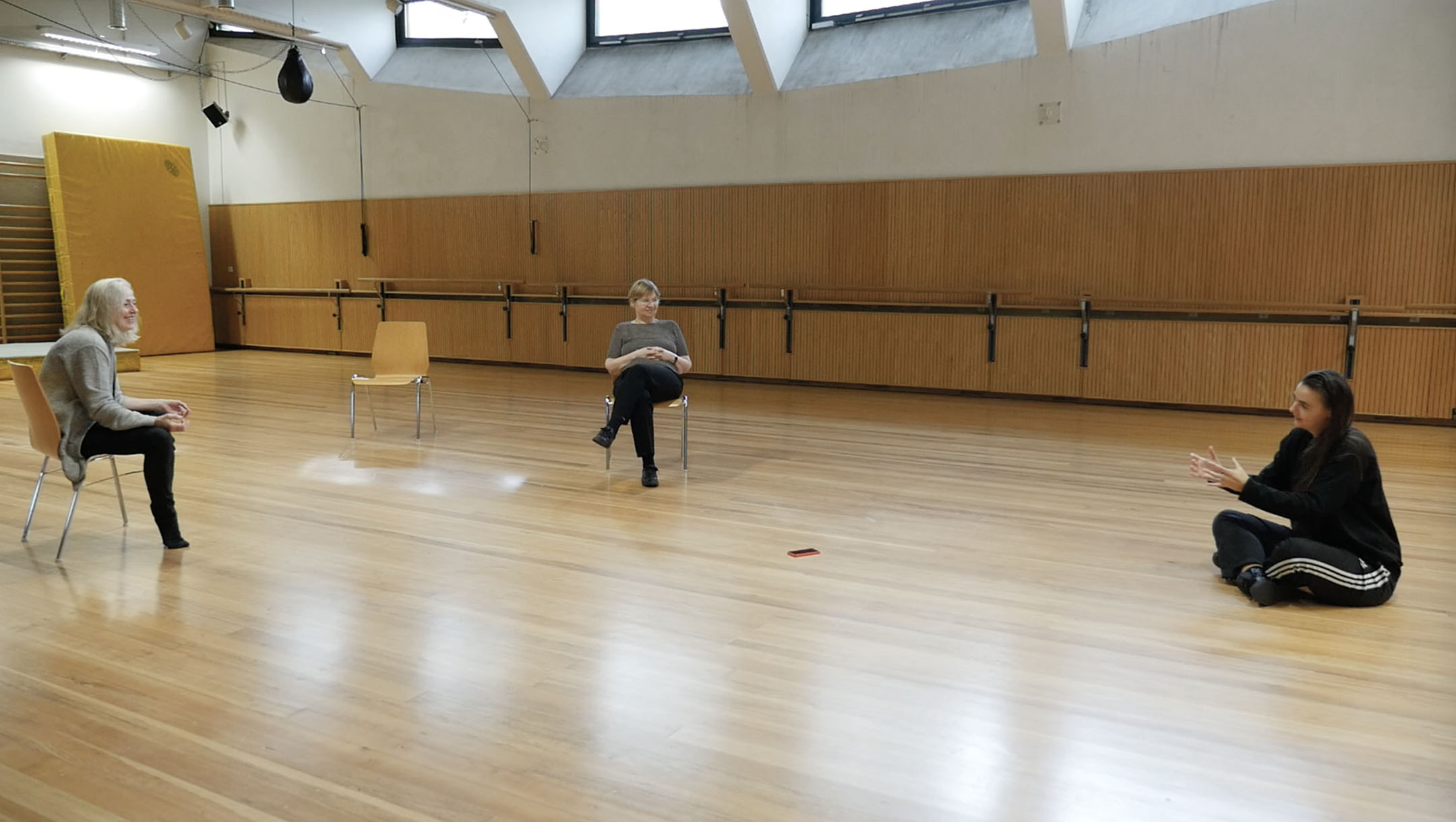
More than an instrument, the Intra-view is an evolving format. Like The Braid, it is rooted in the experience of reflexive studio conversation. Unlike The Braid, it does not offer a structure, but experiments with the intentional removal of strictures, open to working with what flows into their former space instead. This creates a retreat for newly feeling out own, specific ways of knowing. Its first formal iteration under this name, in 2018, was supported by an Art Research Grant from the University of Music and Performing Arts, Vienna. This work contributes to methods discussions in the arts and humanities. It proceeds as a collaboration with professor of Gender Studies, Doris Ingrisch, and in conversation with performing and performance artists. The image above is an intra-view setting, at the Max Reinhardt Seminary in Vienna.
Contextualizing Diagrammatic Instruments
Diagrammatic Instruments are 'middle terms', akin to other structures that both hold and generate meaning, yet are often invisible. Diagrammatic Instruments can best be seen when in motion during use.

Diagrammatic Instruments derive from my fascination with the roles grammar and rhetoric play in making sense. Language and reading, interpretation and attention to articulation feed my work. Part of articulation are the conventions it is channeled through. The traditions carried within the languages we speak also include the permissions and prohibitions that are embodied in organizations and institutions, in turn expressed in the many ways of making sense we carry within our bodies.

Diagrammatic Instruments are interrelated. Performative Topologies mobilized what I learned from the performative uses of The Braid. Micro-practices for a New Gentleness draws on structural permutations the Fractal 3-Line Matrix enables. The Intra-view actively does away with strictures, opening latent spaces of knowing. Much of this work emerges through co-creation, in studio sessions and workshops, as part of seminars, residencies, conferences, and laboratory set-ups in exhibitions.